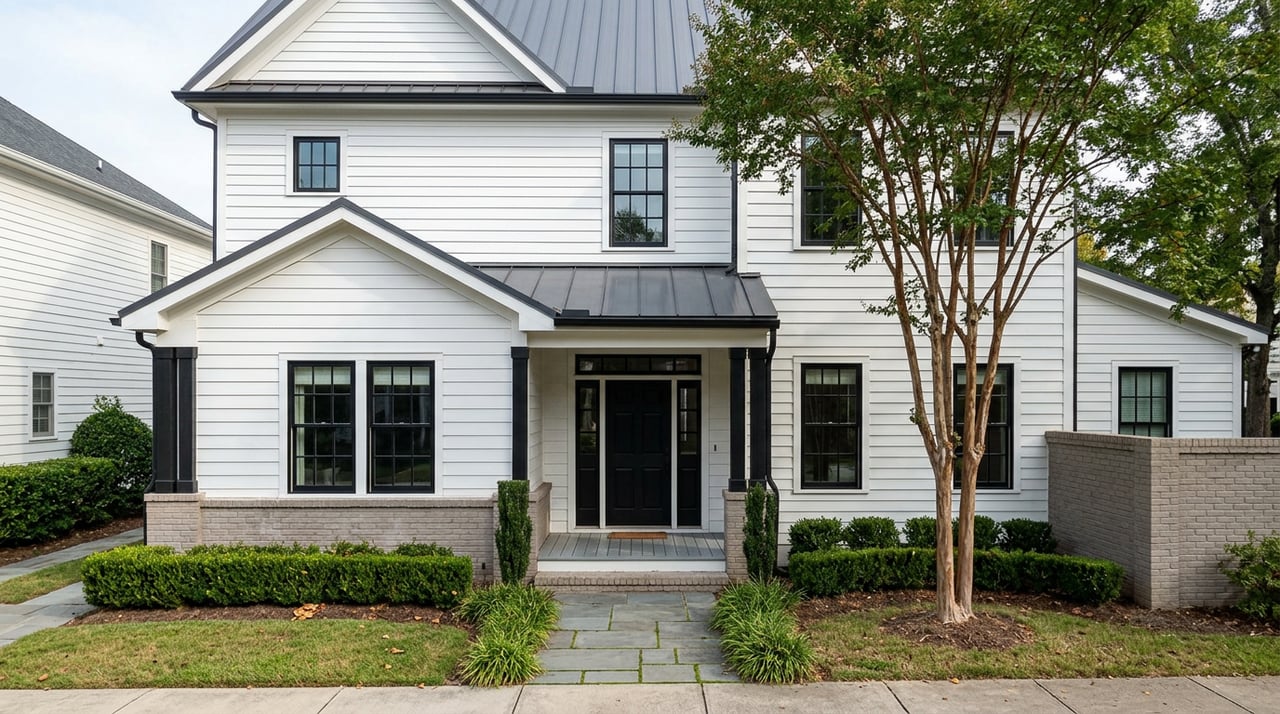
Sylvan Park and The Nations Share a Zip Code. Zoning Is Why They Don't Share a Price.
September 24, 2026
September 24, 2026
A house near Murphy Road sells for $500 a square foot. Four blocks north, past Charlotte Avenue, a house of similar size and a similar decade of construction sells for $388 a square foot. Same zip code, 37209. Same commute into downtown. Same greenway system threading through the west side of the city. A buyer touring both in one afternoon could reasonably assume that one neighborhood has simply pulled ahead of the other in desirability.
That assumption misses the actual story. The gap between Sylvan Park and The Nations isn't primarily about which neighborhood people want more. It's about a zoning decision Metro Council made in August 2025, layered on top of a decade of quieter zoning decisions that already shaped both places. If you're comparing these two neighborhoods on a spreadsheet of median prices, you're looking at the output. The input is a set of council votes, overlay maps, and lot-by-lot rules that most buyers never see until they're deep into a contract.
Over the three months ending in June 2026, the median sale price in Sylvan Park was $1.1 million, up 11.5 percent from the same period a year earlier, with a median price per square foot of $500, up 31 percent year over year. Homes there were taking an average of 56 days to sell, up from 48 the year before, even as sale counts rose.
The Nations tells a different story with similar demand. Active listings there were averaging around $594,000 as of February 2026, with price per square foot closer to $388. By June 2026, one market tracker put the median home price at $649,999 with homes moving in about 49 days. New construction townhomes in the $500,000 to $800,000 range remain the most common transaction type.
Line those numbers up and the gap is substantial, though the precise difference depends on which slice of each market you compare. For two neighborhoods that border each other, share a zip code, and pull from the same pool of west Nashville buyers, that's a wide spread to explain with "vibe" alone.
Part of Sylvan Park sits inside a Neighborhood Conservation Overlay governed by what's known locally as the Park and Elkins guidelines. Homes built before 1945 within that overlay fall under review by the Metro Historic Zoning Commission before an owner can demolish, significantly alter, or rebuild. That review process exists to preserve the 1920s and 1930s bungalow character that gives Sylvan Park its identity. It also functions as a hard limit on how much of the neighborhood's housing stock can be replaced with larger new construction, no matter how strong demand gets.
Outside the overlay, teardown-and-rebuild is still happening, and happening at a price point that would have seemed extreme a few years ago. New builds in Sylvan Park are showing up in the $2 million to $2.75 million range, and local brokers describe the neighborhood as running on roughly four months of housing inventory, which doesn't leave much room for buyers hoping to land a move-in-ready cottage without a bidding war. A proposal to expand the conservation overlay to cover more of the neighborhood was paused in 2025, which means the exact footprint of protected blocks is still not fully settled. What is settled is the pattern: wherever the overlay applies, supply stays tight by design, and tight supply against rising demand is a straightforward recipe for the price-per-square-foot growth Sylvan Park has posted.
The Nations has seen years of ongoing construction, reflecting policy choices as well as market forces. HousingWire reports that about a decade ago, a local ordinance change allowed detached duplexes on residential lots, paired with updates to state law on horizontal property regimes. That change is what produced the neighborhood's signature "tall-skinny" homes, two narrow units built where one house used to stand, often reaching two or three stories and, more recently, crossing the $1 million mark.
In August 2025, Metro Council took that trajectory and formalized it at a much larger scale. Councilmember Rollin Horton's Nations Neighborhood Plan, an Urban Design Overlay covering roughly 300 acres, passed after nearly two years of development and more than 20 community meetings. The rezoning portion passed 25-9 with one abstention, and the UDO itself passed 27-6. Under the new rules, most standard residential lots can now hold up to four homes instead of one, most new buildings are capped at two stories or 35 feet, accessory dwelling units are permitted, and the plan adds stormwater drainage and tree canopy requirements that weren't there before. An amendment added during the vote also bans short-term rentals in new construction, though existing rentals are unaffected. You can read the full overlay document Metro Council approved if you want the underlying language rather than a summary of it.
The practical effect is that The Nations is now permitted to keep adding housing units at a pace Sylvan Park's overlay structure doesn't allow. More permitted supply, even when demand is strong, tends to hold down price-per-square-foot growth relative to a neighborhood where supply is capped. That's most of the explanation for why $388 a square foot in The Nations and $500 in Sylvan Park can exist four blocks apart in the same zip code.
The zoning difference isn't just an academic point. It shows up directly in what a buyer needs to check before writing an offer.
In Sylvan Park, the friction is renovation timeline. If you're buying a pre-1945 home inside the conservation overlay planning to add a second story or reconfigure the front elevation, budget for a design review process through the Metro Historic Zoning Commission before you budget for the contractor. That review adds weeks, sometimes longer, and it can constrain what you're allowed to change on the exterior even if your architect has a different vision.
In The Nations, the friction is construction quality variance. A decade of rapid infill has produced a wide range of builders and finish levels sitting on the same block, so a home inspection matters more there than it might in a neighborhood with more uniform, older housing stock. Certain blocks, particularly along the Charlotte Avenue edge, have documented stormwater issues, standing water after heavy rain that predates the new drainage requirements in the UDO. Checking a FEMA flood map and pulling insurance claims history on the specific address is worth the extra step before you're under contract, not after.
It would be tidy to conclude that The Nations' rezoning will steadily close the gap with Sylvan Park as new supply comes online over the next decade. The reality is more complicated. New construction single-family homes and townhomes in The Nations and the surrounding 37209 zip code are already routinely listing between $700,000 and $1.5 million, not at entry-level prices. A neighborhood advocacy group has argued that in a hot market like Nashville's, replacing older, more affordable homes with new high-end product tends to push the neighborhood's overall price level up rather than down, at least in the near term, even while it adds total housing units.
That doesn't mean the UDO fails on its own terms. Adding four permitted homes where one stood before does expand the total housing stock, which is the long-run lever that eventually tempers price growth across a market. But a buyer shopping The Nations today shouldn't expect the rezoning to produce a wave of newly affordable inventory next year. What it's more likely to produce, at least for the next several years, is continued construction activity, continued variance in build quality, and continued upward pressure on new-build prices even as the overall gap to Sylvan Park persists.
If you want a finished, protected streetscape with predictable character and are prepared to pay for scarcity, Sylvan Park is the more defensible long-term hold, and the zoning that protects its bungalow blocks is also what keeps its inventory tight and its prices climbing. If you want more house for the dollar today and are comfortable buying into a neighborhood that's still actively being built out under a fresh regulatory framework, The Nations offers real value, with the tradeoff being more due diligence on the individual builder and block rather than the neighborhood as a whole.
Neither is the wrong answer. They're two different bets on how a zoning line shapes a market, sitting less than half a mile apart.
Will the price gap between Sylvan Park and The Nations close over time? It may narrow as new supply comes online in The Nations, but new construction there is already pricing well above entry-level, so a fast convergence isn't guaranteed. Sylvan Park's overlay-driven scarcity gives it a structural reason to keep appreciating regardless of what happens next door.
Does the 2025 rezoning affect homes that are already built in The Nations? The UDO governs new construction and redevelopment going forward. Existing homes and existing rentals are not retroactively affected, though a lot's future redevelopment potential, and therefore its resale appeal to a builder, is shaped by the new density and height rules.
Is Sylvan Park's conservation overlay citywide or specific to certain blocks? It applies to specific blocks under the Park and Elkins guidelines, not the entire neighborhood. A proposal to expand that footprint was paused in 2025, so the exact boundary is worth confirming block by block rather than assuming it applies uniformly.
If you're weighing a move into either of these neighborhoods, or trying to figure out what a specific address's zoning actually allows before you write an offer, The Milam Group can walk you through the block-level details that don't show up on a listing sheet. Schedule a personalized market consultation and we'll help you read the zoning map before you read the price tag.
This article is general information, not legal, tax or financial advice. Consult a qualified professional about your situation.

Where to Find Outdoor Dining in Franklin, TN, From Riverside Patios to a Downtown Rooftop.
Reasons Buyers Choose to Invest in Franklin, TN, From Downtown Charm to Open Green Space.

How To Shape a Franklin, TN, Home That's Ready for Guests.

Donnel Milam
[email protected]
Bob Milam
[email protected]
Address
5200 Maryland Way, Suite 101
Brentwood, TN 37027
Office
(615) 263-4800
Direct
(615) 414-9069